EcoSur consultancy in the Philippines

Foto: Solidar
One year ago we reported about the EcoSur consultancy to the Swiss NGO “Solidar” for their reconstruction after typhoon “Yolanda”. “Build Back Better” was the overriding theme for the project design. Intermediate evaluations show now that the project is well underway and the overall objectives will be fulfilled. The quality of construction is excellent, the houses are solid and take up the typical local architecture, but with decisive improvements to make them more resilient.
by Kurt Rhyner
Yolanda was the strongest typhoon ever recorded in Asia and it caused massive destruction on some of the Philippine Islands. Within a few weeks of the event, Solidar distributed emergency kits to some 2,400 families and called an EcoSur expert to design a scheme for reconstruction. Most of the simple bamboo huts of the poorer sectors of the population had been destroyed, but also may more solid houses had suffered much damage, mostly it was the galvanized metal sheets that were torn off.
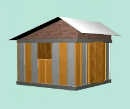
When the international donor community retreated from Haiti, the experiences of this post-earthquake reconstruction was evaluated in several conferences of the “emergency cluster” of UN habitat and the conclusion reached was “never again intermediate shelters”. The Solidar management supported this point of view and the EcoSur expert looked for a simple permanent dwelling at low cost. He presented a design that combines the local architectural style with high resistance against earthquakes, winds and inundations. The support structure should last 50 years, the roof and its cladding should be good for about half that time, the infills in the walls as well as windows and doors should have a lifespan of at least 10 years. First plans and renderings were made by the architects at sofonias Nicaragua and Javier, a Spanish engineer from the EcoSur team in Haiti was hired by Solidar to direct the project.
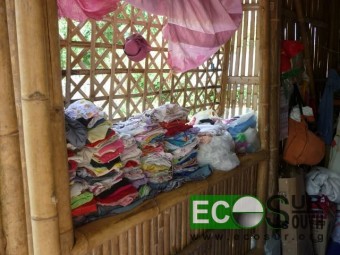 The reconstruction project was approved in June 2014 and in the first year they have built more than 400 solid houses and have helped more than 500 families to repair or improve their dwelling. A survey shows that almost all beneficiaries are convinced that their new house will withstand a heavy typhoon, a young mother of three said “this house will be here when I am gone”. An important detail for the satisfaction everybody expresses, is the fact that traditional details have been incorporated, like the bay windows that give some shelf space inside the house.
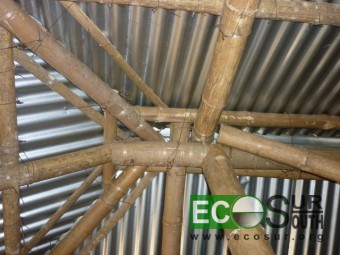
 The core houses have a good foundation and a lower wall made of locally produced hollow blocks. Javier, the project coordinator has developed systems to fix the bamboo poles in ways to assure a long useful life and the wall and roof structures are well designed to withstand strong winds. It can safely be assumed that they will resist any typhoon for at least 10 years, all bamboo connections are tied with fishing-line. The houses are cool because the wind crosses the bamboo weaves of the windows and the vertical bamboo strips of the walls.
Construction with bamboo is not always recommended, most varieties of this fast growing plant have a short life, attacks by fungi and termites are often deadly in less than five years and preservation of bamboo is not that simple or low cost. However, in the project area everybody insists that the local species are good for 15 years and we have seen 20 year old structures that withstood the typhoon. It seems the locals do not make great effort for preservation, but Javier is applying the simple method of spraying with kerosene, something that is easy to do for the beneficiaries in the future.
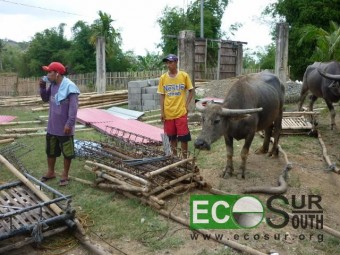 The project works in the mountainous regions of the Panay Island, in places where the other NGO's don’t go because it is too far and too difficult. Some villages have no road access and the beneficiaries have to transport the materials with buffalo’s, motorbikes and on their backs. The social and the technical team work together to decide which family will receive what type of help, depending on their own possibilities and the level of damage their house suffered in Yolanda. Most of that work has to be done walking up and down steep hills, and when the rainy season starts it will be even more demanding.
The project is developing well and will in the next year build about 700 more houses and retrofit another 700, also build 650 toilets with shower stall. It is not just the beneficiaries who are enchanted with their new house, also all visitors from the donor community express their admiration for good design and implementation.